
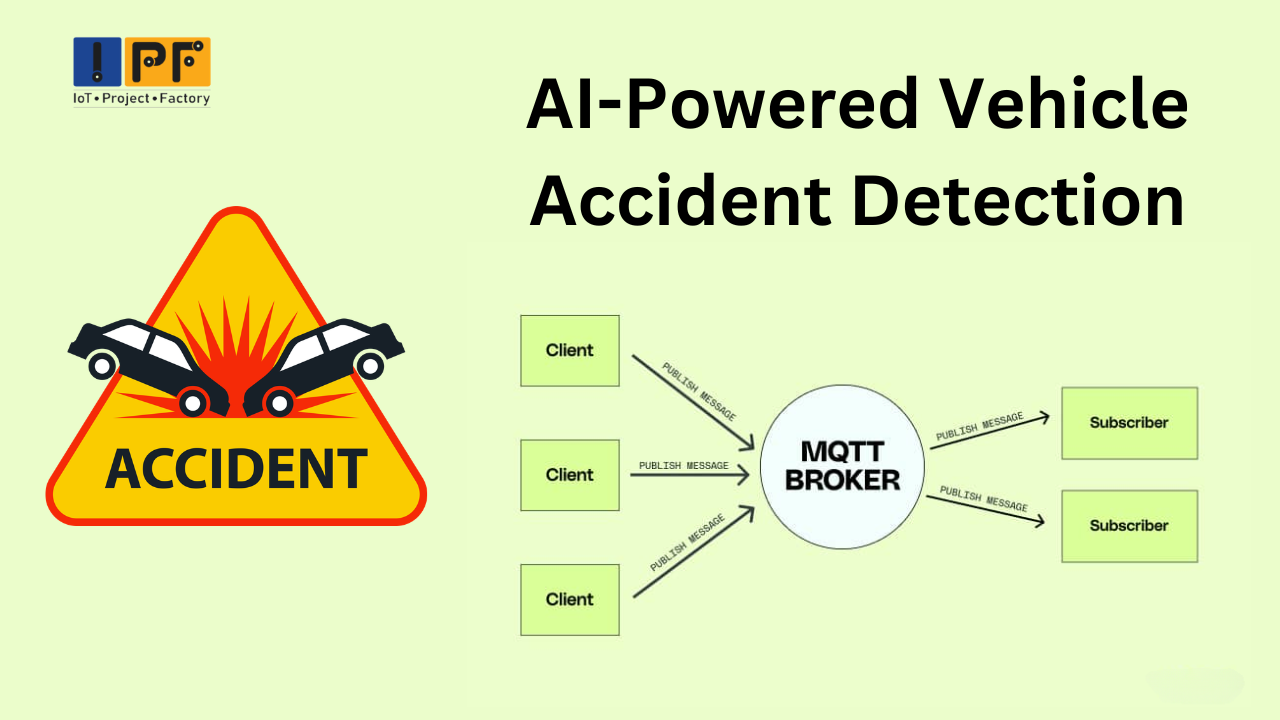
AI-Powered Vehicle Accident Detection: IoT Project 2026
Table of Contents
Launch your IoT product in a few weeks for MVP
Learn more
Introduction
Road accidents need fast response. An AI-Powered Vehicle Accident Detection system helps detect crashes in real time, notify emergency contacts, and share live vehicle location through a mobile app.
As an IoT app development company, we build complete vehicle safety solutions using sensors, AI models, cloud MQTT communication, backend APIs, and mobile applications.
What Is AI-Powered Vehicle Accident Detection?
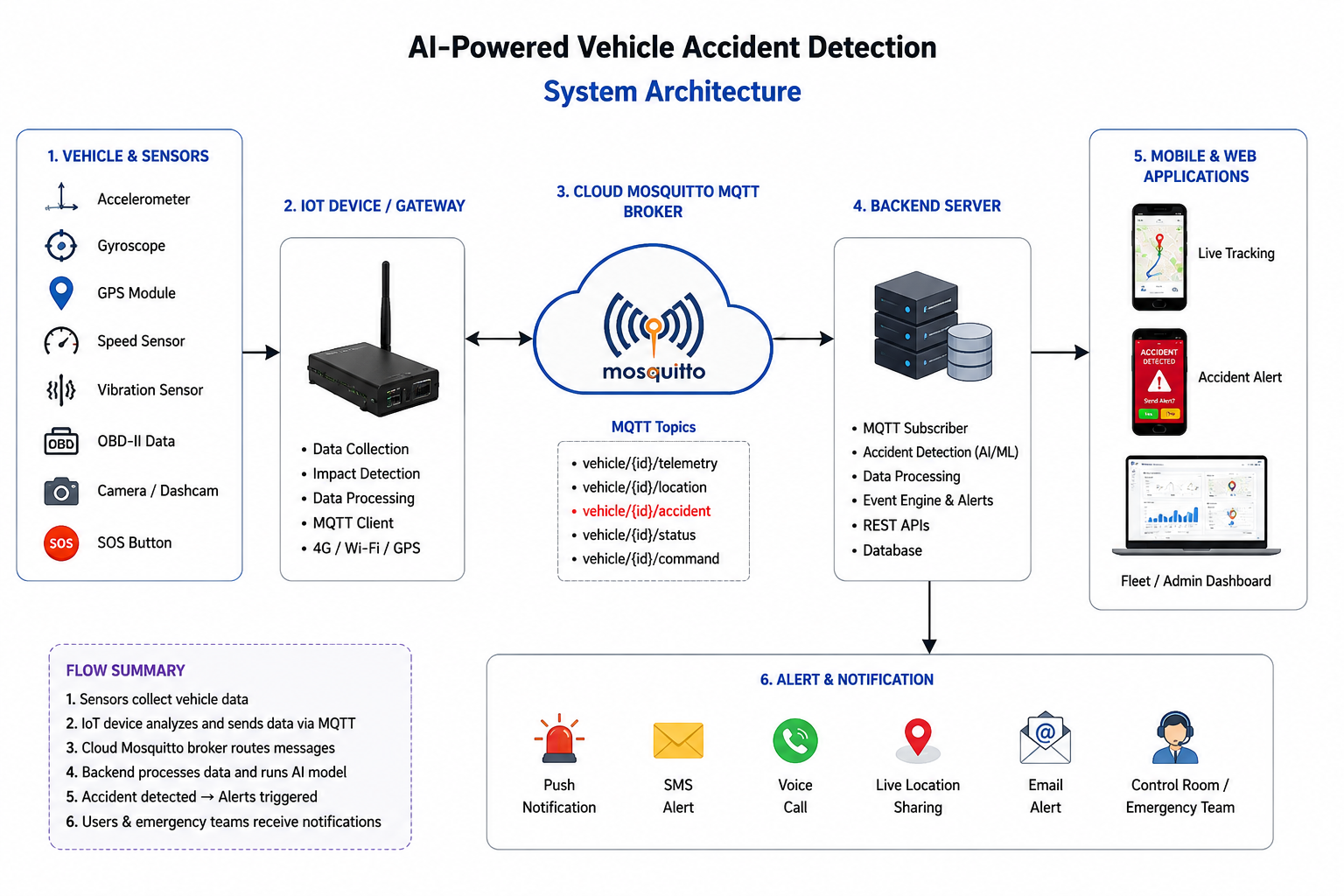
AI-powered accident detection is a smart vehicle monitoring system that collects real-time data from vehicle sensors, GPS, accelerometer, gyroscope, and mobile devices.
The system analyzes sudden impact, abnormal movement, vehicle tilt, harsh braking, and location data to detect possible accidents. Once detected, it sends instant alerts to drivers, family members, fleet managers, or emergency teams.
Why Businesses Need Smart Accident Detection
Traditional accident reporting depends on manual calls or delayed information. AI-based detection improves response time and safety.
It helps with:
- Real-time accident detection
- Faster emergency response
- Live vehicle tracking
- Driver safety monitoring
- Fleet risk management
- Automatic alerts
- Trip history and reports
- Reduced response delay
Sensors and Data Sources Used
Depending on the vehicle type and use case, we integrate multiple sensors and data sources.
| Sensor / Source | Purpose |
|---|---|
| Accelerometer | Detects sudden impact or crash force |
| Gyroscope | Detects vehicle tilt, roll, or abnormal rotation |
| GPS Module | Tracks live vehicle location |
| Speed Sensor | Monitors speed changes |
| Vibration Sensor | Detects impact vibration |
| OBD-II Data | Reads vehicle diagnostics and speed |
| Camera / Dashcam | Supports AI-based visual accident analysis |
| Mobile Phone Sensors | Uses phone motion data for accident detection |
| SOS Button | Allows manual emergency alert |
Why We Choose Cloud Mosquitto MQTT
For this system, we use Cloud Mosquitto MQTT instead of AWS IoT because it is lightweight, cost-effective, and ideal for real-time vehicle telemetry.
Cloud Mosquitto MQTT helps with:
- Fast MQTT message communication
- Low-latency vehicle data transfer
- Cost-effective cloud setup
- Easy device integration
- Secure TLS communication
- Scalable pub/sub architecture
- Simple backend integration
- Real-time alerts and tracking
This makes Mosquitto MQTT a practical choice for MVPs, fleet monitoring platforms, and custom vehicle safety applications.
End-to-End Development Process
Step 1: Requirement Analysis
We first understand the use case: private vehicles, school buses, logistics trucks, taxis, delivery fleets, or rental cars.
We define:
- Vehicle type
- Number of vehicles
- Required sensors
- Alert workflow
- Emergency contacts
- Mobile app roles
- Dashboard requirements
Step 2: Hardware and Sensor Selection
We choose the right IoT hardware based on accuracy, connectivity, and budget.
Common hardware includes:
- ESP32 or industrial IoT gateway
- GPS module
- Accelerometer and gyroscope sensor
- GSM/4G module
- OBD-II device
- Camera or dashcam
- Backup battery
- SOS button
Step 3: IoT Firmware Development
We develop firmware that collects vehicle sensor data and publishes it to Cloud Mosquitto MQTT.
Firmware handles:
- GPS data reading
- Impact detection
- Speed monitoring
- Sensor calibration
- Offline buffering
- MQTT reconnect logic
- Secure TLS connection
- Device health status
Step 4: Cloud Mosquitto MQTT Setup
We configure a cloud-hosted Mosquitto MQTT broker for real-time communication between vehicle devices and backend services.
Typical flow:
Vehicle Sensors → IoT Device/Gateway → Cloud Mosquitto MQTT → Backend API → Database → Mobile AppMQTT topics can include:
vehicle/{vehicleId}/telemetry
vehicle/{vehicleId}/location
vehicle/{vehicleId}/accident
vehicle/{vehicleId}/status
vehicle/{vehicleId}/command
Step 5: AI Accident Detection Logic
We build AI/ML logic to reduce false alerts and improve detection accuracy.
The system checks:
- Sudden acceleration spike
- Sharp deceleration
- Roll or tilt angle
- Impact vibration
- Speed before impact
- Vehicle stop after impact
- GPS movement pattern
- Optional dashcam image analysis
The AI model can classify events such as:
- Minor impact
- Major accident
- Rollover
- Harsh braking
- False alarm
- Manual SOS
Step 6: Backend Development
The backend subscribes to MQTT topics, processes incoming data, stores accident events, and sends alerts.
Backend features include:
- Vehicle management
- Driver management
- Trip tracking
- Accident event processing
- Emergency contact mapping
- Alert rules
- Location history
- Reports and analytics
- Admin dashboard APIs
Step 7: Mobile App Development
We develop Android and iOS mobile apps for drivers, vehicle owners, family members, and fleet admins.
The app displays live location, trip status, accident alerts, and emergency actions.
Step 8: Alerts and Emergency Workflow
When an accident is detected, the system can:
- Send push notification
- Send SMS alert
- Send email alert
- Call emergency contact
- Share live GPS location
- Start emergency countdown
- Allow driver to cancel false alert
- Notify fleet admin dashboard
Step 9: Testing and Deployment
We test the complete system in real driving conditions.
Testing includes:
- Sensor calibration
- Crash pattern simulation
- Harsh braking tests
- MQTT reliability
- GPS accuracy
- Alert delivery time
- Mobile app performance
- False positive reduction
Mobile App Features
Our accident detection mobile app can include:
- Live vehicle tracking
- Accident alert screen
- Emergency SOS button
- Driver safety score
- Trip history
- Harsh braking alerts
- Speed alerts
- Vehicle health status
- Emergency contact management
- Push notifications
- Fleet dashboard
- Accident reports
- Route history
- Multi-vehicle management
Estimated Cost and Timeline
The cost depends on hardware, number of vehicles, AI complexity, mobile app features, and dashboard requirements.
| Module | Timeline |
|---|---|
| Requirement and planning | 1 week |
| Hardware and sensor integration | 2–3 weeks |
| Cloud Mosquitto MQTT setup | 1 week |
| Backend development | 3–5 weeks |
| AI accident detection logic | 3–4 weeks |
| Mobile app development | 4–6 weeks |
| Testing and deployment | 2 weeks |
Estimated total timeline: 10–14 weeks for a complete MVP.
Cost depends on:
- Number of vehicles
- Sensor type
- GPS accuracy requirement
- Android only or Android + iOS
- AI model complexity
- Fleet dashboard features
- SMS/calling integration
- Cloud hosting and MQTT broker setup
Benefits for Fleet Owners and Users
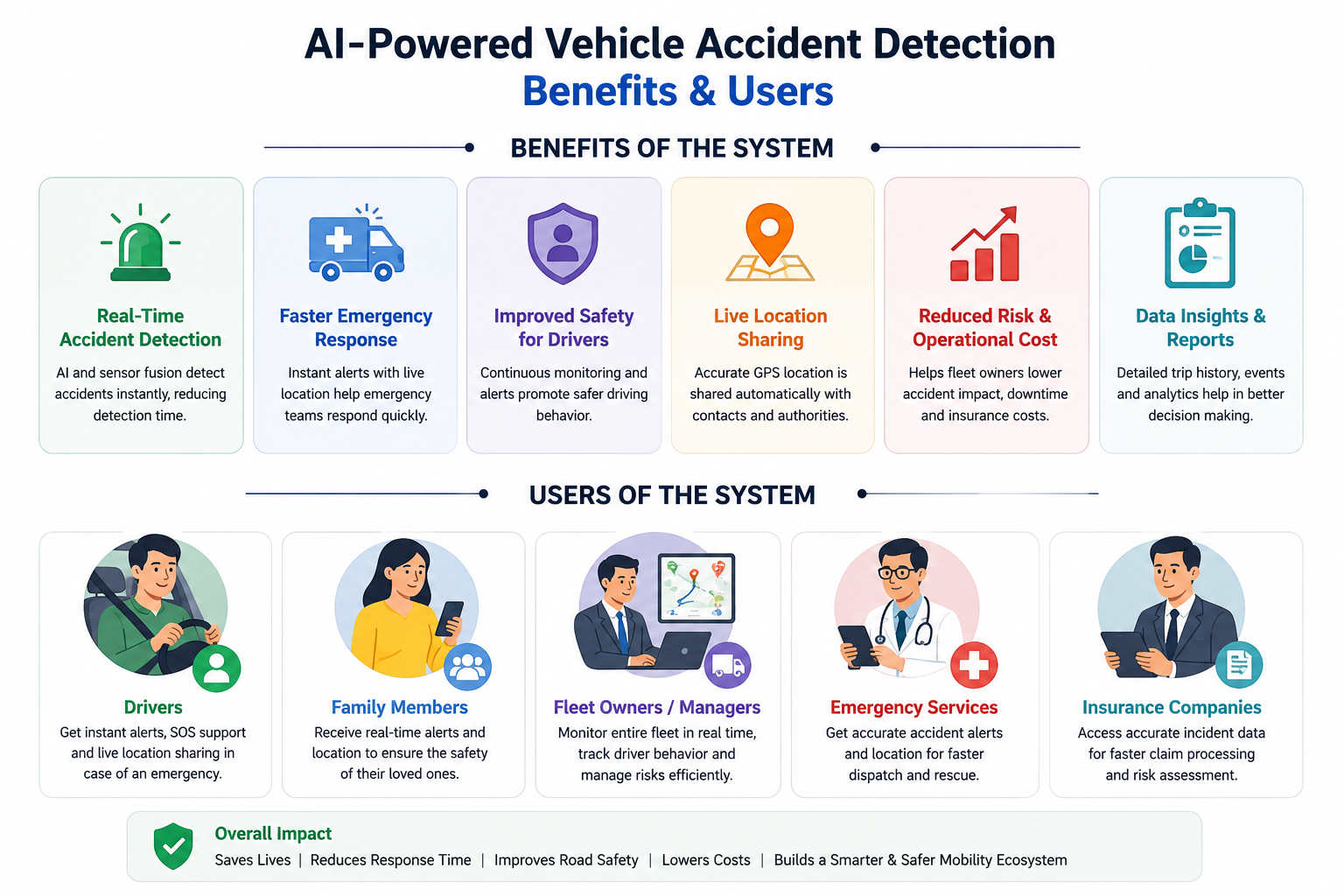
An AI-powered accident detection system improves safety and reduces emergency response time.
Key benefits:
- Faster accident alerts
- Live GPS location sharing
- Better driver safety
- Reduced emergency delay
- Fleet risk monitoring
- Automated incident reporting
- Real-time vehicle visibility
- Improved customer trust
Why Choose Our IoT App Development Services
We provide complete IoT app development services for connected vehicle and fleet safety solutions.
Our team helps with:
- IoT consulting
- Vehicle sensor selection
- Firmware development
- Cloud Mosquitto MQTT setup
- Backend API development
- AI accident detection logic
- Android and iOS app development
- Fleet dashboard development
- Testing and deployment
- Maintenance and support
Whether you want to build an accident detection MVP, fleet safety platform, or connected vehicle monitoring system, we can develop a secure, scalable, and real-time IoT solution.
Conclusion
An AI-Powered Vehicle Accident Detection system combines IoT sensors, AI algorithms, Cloud Mosquitto MQTT, backend APIs, and mobile apps to detect accidents and send instant alerts.
It helps vehicle owners, fleet companies, schools, logistics businesses, and transport operators improve safety and emergency response.
If you are planning to build a smart vehicle safety solution, our IoT app development team can design, develop, and deploy the complete platform from hardware to mobile app.
Looking for an IoT app development company for AI-powered accident detection? Contact us today to build your custom connected vehicle safety solution.
Looking for an IoT app development partner?
Are you looking for a reliable partner to help you build a stunning IoT companion app? You're in the right place.
We have 6+ years of experience building a variety of IoT apps, from healthcare to HVAC. So, if you go with us, you'll be in safe hands.
If you want to learn more, feel free to reach out and our team will be happy to set up a call to discuss your needs in more detail.
Get in touch

