
Smart Irrigation System Using IoT: End-to-End Mobile App Development Guide
Table of Contents
Launch your IoT product in a few weeks for MVP
Learn more
Introduction
Water management is one of the biggest challenges in modern farming. A Smart Irrigation System Using IoT helps farmers monitor soil, weather, water flow, and crop conditions in real time through a mobile app.
As an IoT app development company, we build complete smart irrigation solutions that connect field sensors, cloud platforms, and mobile applications into one powerful system.
What Is a Smart Irrigation System Using IoT?
A smart irrigation system uses IoT sensors installed on farmland to collect live data such as soil moisture, temperature, humidity, water level, rainfall, and flow rate.
This data is sent to the cloud and displayed in a mobile app. Farmers can then decide when to irrigate, how much water to use, and whether pumps or valves should be controlled manually or automatically.
Why Farmers Need Smart Irrigation
Traditional irrigation often wastes water and depends on guesswork. IoT-based irrigation solves this by offering:
- Real-time farm monitoring
- Accurate water usage
- Reduced manual work
- Better crop health
- Lower electricity and water bills
- Remote pump and valve control
- Data-driven farming decisions
Key Sensors Used in Smart Irrigation
For our client farmer’s land, we usually install sensors based on the crop type, land size, and irrigation method.
Common sensors include:
| Sensor Type | Purpose |
|---|---|
| Soil Moisture Sensor | Checks water level in soil |
| Temperature Sensor | Monitors field temperature |
| Humidity Sensor | Tracks air moisture |
| Rain Sensor | Detects rainfall |
| Water Flow Sensor | Measures water usage |
| Water Level Sensor | Monitors tank or borewell level |
| pH Sensor | Checks soil or water quality |
| EC Sensor | Measures nutrient concentration |
Why We Choose AWS IoT Cloud
For a reliable smart irrigation platform, we recommend AWS IoT because it is secure, scalable, and suitable for real-time device communication.
AWS IoT helps us with:
- Secure device authentication
- MQTT-based communication
- Real-time data processing
- Device shadow for offline/online sync
- Easy integration with mobile apps
- Scalable infrastructure for many farms
- Cloud storage and analytics
Using AWS IoT, we can start with one farm and scale the same platform to thousands of connected devices.
End-to-End Development Process
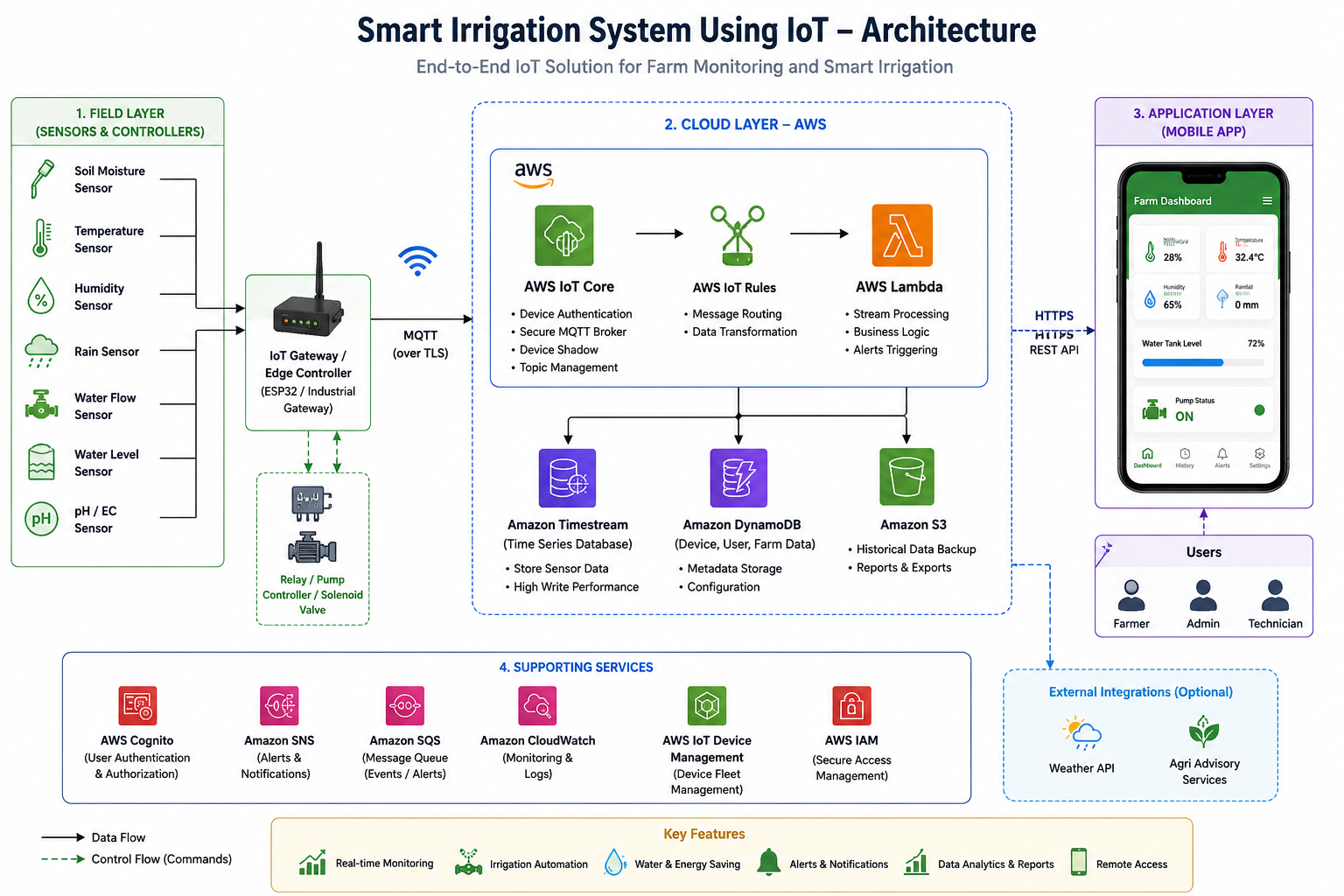
Step 1: Requirement Analysis
We first understand the farmer’s land, crop type, water source, irrigation method, internet availability, and automation needs.
This helps us define the right sensors, hardware, cloud architecture, and mobile app features.
Step 2: Sensor and Hardware Selection
Based on the requirement, we choose suitable IoT sensors, microcontrollers, gateways, relay modules, pump controllers, and power options such as solar or battery backup.
Step 3: IoT Device Firmware Development
We develop firmware for the IoT device to collect sensor data and send it to AWS IoT using MQTT protocol.
The firmware also handles:
- Sensor reading
- Device health check
- Offline data handling
- Pump/valve control
- Secure cloud communication
Step 4: AWS IoT Cloud Setup
We configure AWS IoT Core for device registration, certificates, policies, topics, and secure communication.
Typical cloud flow:
IoT Sensors → Gateway/Controller → AWS IoT Core → Database → Backend API → Mobile AppStep 5: Backend Development
We build a backend system to process sensor data, manage users, handle farms, generate alerts, and store historical data.
Backend features include:
- Farmer profile management
- Farm and device mapping
- Sensor data storage
- Alert rules
- Pump automation logic
- Analytics dashboard APIs
Step 6: Mobile App Development
We develop Android and iOS mobile apps where farmers can monitor and control irrigation in real time.
The app shows live sensor values, alerts, irrigation status, and historical trends.
Step 7: Alerts and Automation
The system can send alerts when:
- Soil moisture is too low
- Tank water level is low
- Pump is running too long
- Rain is detected
- Sensor goes offline
- Abnormal water flow is detected
Automation rules can also turn pumps or valves ON/OFF based on soil moisture and crop needs.
Step 8: Testing and Field Deployment
Before launch, we test the full system in real farm conditions.
Testing includes:
- Sensor accuracy
- Mobile app performance
- Cloud connectivity
- Pump control response
- Alert delivery
- Offline handling
Mobile App Features
Our smart irrigation mobile app can include:
- Live soil moisture monitoring
- Temperature and humidity tracking
- Pump ON/OFF control
- Valve control
- Water tank level monitoring
- Farm-wise device dashboard
- Alerts and notifications
- Historical charts
- Weather-based irrigation suggestions
- Multi-farm management
- Role-based access for farmers, admins, and technicians
Estimated Cost and Timeline
The cost of smart irrigation app development depends on land size, number of sensors, automation level, mobile app features, and cloud usage.
Approximate development estimate:
| Module | Timeline |
|---|---|
| Requirement and planning | 1 week |
| Hardware and sensor integration | 2–3 weeks |
| AWS IoT setup | 1–2 weeks |
| Backend development | 3–5 weeks |
| Mobile app development | 4–6 weeks |
| Testing and deployment | 2 weeks |
Estimated total timeline: 8–12 weeks for a complete MVP.
Cost usually depends on:
- Number of sensors
- Android only or Android + iOS
- Manual or automatic irrigation
- Dashboard complexity
- Analytics and reporting
- Cloud infrastructure
For an accurate estimate, we evaluate the farm size, crop type, and business requirements.
Benefits for Farmers and Agritech Businesses
A smart irrigation system helps farmers save water, reduce manual effort, and improve crop productivity.
For agritech businesses, it creates a scalable digital farming product that can be sold to multiple farmers, farms, cooperatives, and agriculture companies.
Key benefits:
- Water saving
- Better crop yield
- Remote monitoring
- Lower operating cost
- Smart automation
- Real-time alerts
- Data-driven agriculture
Why Choose Our IoT App Development Services
We provide complete IoT app development services from hardware integration to cloud setup and mobile app development.
Our team helps with:
- IoT consulting
- Sensor selection
- Firmware development
- AWS IoT cloud setup
- Backend API development
- Android and iOS app development
- Dashboard development
- Testing and deployment
- Maintenance and support
Whether you want to build a smart irrigation MVP or a full-scale agritech IoT platform, we can develop a secure, scalable, and farmer-friendly solution.
Conclusion
A Smart Irrigation System Using IoT is no longer just a technology upgrade. It is a practical solution for water saving, crop monitoring, and smart farming.
With sensors, AWS IoT cloud, backend APIs, and a mobile app, farmers can monitor their land in real time and make better irrigation decisions.
If you are planning to build a smart irrigation app for farmers, our IoT app development team can help you design, develop, and deploy the complete solution from start to finish.
Looking for a reliable IoT app development company for smart irrigation? Contact us today to build your custom smart farming solution.
Looking for an IoT app development partner?
Are you looking for a reliable partner to help you build a stunning IoT companion app? You're in the right place.
We have 6+ years of experience building a variety of IoT apps, from healthcare to HVAC. So, if you go with us, you'll be in safe hands.
If you want to learn more, feel free to reach out and our team will be happy to set up a call to discuss your needs in more detail.
Get in touch

